RESEARCH
HOMEThis is a page for all of my research that i do for fun, i really want to learn more this year about tons of different stuff, so im going to make it a goal to research topics im interested in as much as i can, this will include: religion, history, art, philosophy, and hopefully much more.
SACRED GEOMETRY
sacred geometry refers to different patterns that are said to be representations of the greater universe and life itself. It is the connection and balance between physical and spiritual. It is used in art, construction, meditation, religion and a lot more.
THE EGG OF LIFE:
The egg of life is called this because it is the starting point
of most other sacred geometry patterns. it is also called
this because it is the first 3d shape that a fetus exists as.
when an egg cell divides, it is 2d until it divides into 8
cells in which it becomes 3d, so the egg of life is the first
formation in which we experience the 3d world.
THE FLOWER OF LIFE:
This pattern is the coolest ever because it has been found in
so many different places such as Egyptian, Hindu,
Christian, Buddhist, Muslim, and Judaic artwork. The
earliest depiction of it has been dated to 645 B.C. based on
Assyrian relics. its meant to represent the structure of our
universe and of life itself, a balance between the divine
feminine and sacred masculine.
SRI YANTRA:
A pattern / diagram used in Hindu and Buddhist practice
such as ceremonies and meditation, its incredibly intricate
and has a meaning for every single shape in the pattern.
The four triangles pointing up to the heavens represent
masculine energy, They reflect strength, awareness, and
expansion. The five triangles pointing down to the earth
represent feminine energy, They express creativity,
intuition, and nurturing. This pattern of triangles is
usually surrounded by a circle of lotus petals which
represent spiritual awakening.
there is much more to be said about sacred geometry and im still interested in learning more about it but ill come back to it on a later date ig.
The pandemic caused our social media related identity issues An essay I posted on Substack

We all know the pandemic had a disastrous affect on global society. In just one year over 1 million people had died from this illness. The world was affected economically, politically, and socially. But I never see anyone talking about how the pandemic impacted children and their identities.
Before I talk about the impacts it is important to first establish what childhood looked like during the pandemic.
There is a complex nostalgia that comes with the memory of 2020 that makes it very hard to write and think about. Children during the pandemic, such as myself, spent their time staring at a pixelated version of what their childhood could have and should have been. Hobbies consisted of what digital media one was consuming, rather than a physical activity. Some spent their time playing video games, some started watching anime, some read fan-fiction, some spent their time wandering through the rabbit hole that is YouTube. Most spent a significant amount of time consuming sort from media through TikTok or Instagram.
Education switched from an interactive, active environment, to a stationary devise in a stationary place. Participation was scarce and most people would mute their mic, and turn off their camera in order to do something else and not pay attention This mindset of switching tabs between a slither.io game and a class assignment has stuck with me even through high school when the world had “returned” to normal.

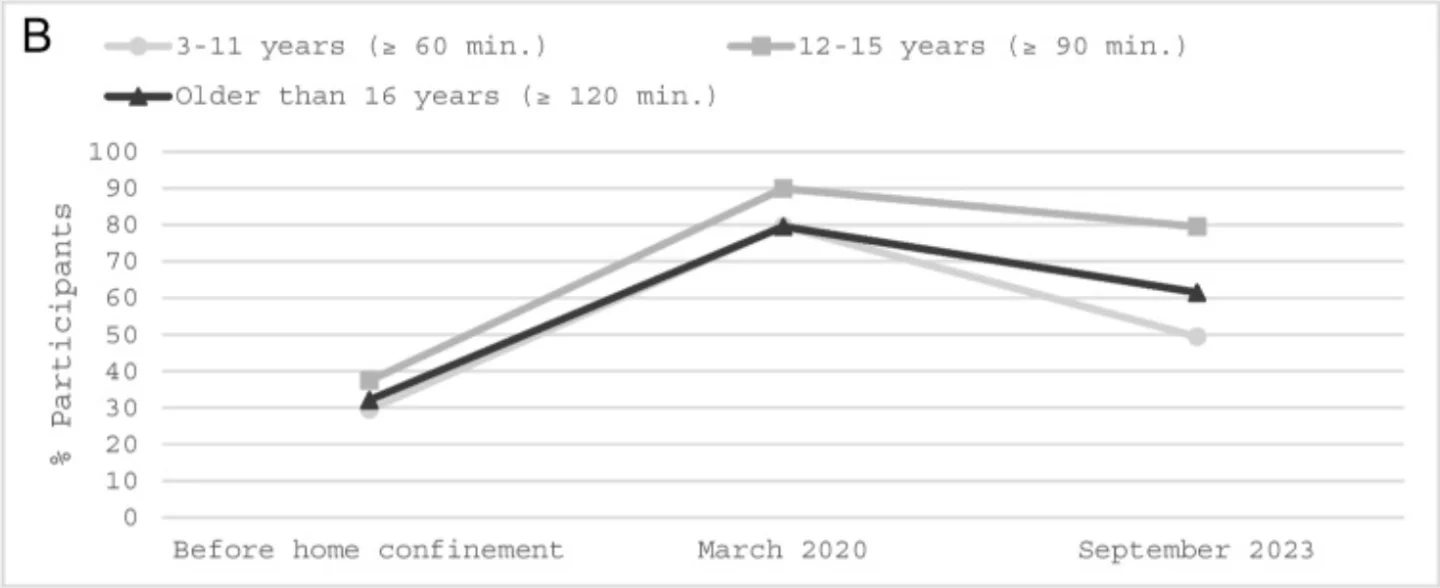
(Graph of children’s screen time before during and after home confinement of the pandemic. Taken from a study done by the National Library of Medicine https://pmc.ncbi.nlm.nih.gov/articles/PMC12457492/ hopefully I cited this correctly)
So how did this affect children’s future identities?
I think the time spent on social media affected the way that teenagers and young adults now use social media and even how they see the world. It is no secret how much social media is dependent on trends, that’s not new at all. But the amount of time spent doing nothing meant a lot of anything was needed in order to fill the attention and stimulate a user. This is why I think trends were such a big thing going forward.
The way that these trends filled the internet affected how users identified. For example: an identity correlated with a certain “side of TikTok”. “Gay-tok”, “Straight-tok”, “Book-tok”, “Alt-tok”, etc. another example of this would be the way people classified their style: Alt, Viscogirl, E-girl/boy, indie, downtown, kawaii, etc. This way of classifying things into “aesthetics” is still so present in present day expression. Take the present day terms such as: whimsical, and looksmaxxing as an example.
I could go on about my experience and perspective on 2020 activities, but let’s get to the point. Why is this important to reflect on? Why does it feel like we just moved and ignored this collective trauma? And why the hell am I so captivated by this topic?
From my perspective, the transition from lockdown to the ordinary system has been focussed on the idea of restoration. Making things resemble the old days of pre-covid instead of focusing on recovery, and completely ignoring children.
Teenagers and young adults are still just as glued to the screen as we were in the pandemic. Wouldn’t you say that our lives would be so much better If we spent our time experiencing the real world instead of social media?
In my opinion, our effort as a society was put into restoration. Whether it was restoring how we spend our day to day life, school, the economy the health system. And no effort was put into recovery. If I were to create a system that was focussed on the recovery of society after the pandemic, I would focus on children. I would focus on addressing the collective trauma we went through by implementing therapy groups into schools. I would focus on creating technology bans and regulations.
Identity issues, validation that is reliant on social media, overconsumption. All of this could have been avoided If we had just handled post pandemic better.
If you agree with my perspective (which you don’t need to do) consider how the pandemic has affected you. Ask yourself: Is my personal validation reliant on social media? Do I spend time worrying about how many likes my instagram post will get? Do I partake in trends that aren’t related to my personal identity?
Let me know what you think of my opinion on this. i would love to learn about your experience of 2020 as well